An anagram rearranges the letters of a word or phrase into a new arrangement, using each letter exactly once. It’s a small puzzle with a lot of uses: writers hide clues in mysteries, puzzle fans hunt for hidden words, gamers spin fresh usernames out of their own names, and crossword solvers untangle tricky clues. The Anagram Maker takes whatever you type and shuffles its letters into new combinations on demand. It offers two modes — a full letter shuffle, and a split-and-regroup mode that breaks the letters into two chunks so the results read a little more like real words or two-word phrases. Type something with at least three letters and generate as many rearrangements as you want.
Anagram Maker
Rearrange the letters of any word or phrase into new combinations.
These are letter rearrangements, not dictionary-validated words. Verify real words in a dictionary.
How to use the Anagram Maker
- Enter a word or phrase. Anything from “listen” to “dormitory”; letters are used, spaces and punctuation are ignored.
- Choose a mode. “Letter shuffles” scrambles all letters into one string; “Split & regroup” divides them into two groups for a more word-like look.
- Set how many results you want — from 12 up to 40.
- Press Make anagrams. A grid of rearrangements appears, each with a Copy button.
- Scan for real words. The tool shuffles letters; you decide which combinations form actual words or names worth keeping.
What is an anagram?
An anagram is a word, phrase or name formed by rearranging the letters of another, using every original letter exactly once. That last clause is what separates an anagram from a mere jumble: you cannot add a letter, drop one, or use one twice. Listen and silent are anagrams because both contain exactly one each of L, I, S, T, E and N. Listen and listing are not, because the second has a G that the first does not.
The word itself comes from the Greek ana- (“back, again”) and gramma (“letter”). The form has been used seriously and playfully for centuries — by seventeenth-century scientists staking a claim to a discovery without revealing it, by novelists concealing character identities, and by crossword setters ever since the puzzle was invented. The general history is covered well in the overview of the anagram as a literary device.
Types of wordplay people confuse with anagrams
| Form | What it does | Example |
|---|---|---|
| Anagram | Rearranges all letters exactly once | listen → silent |
| Antigram | An anagram meaning the opposite of the original | restful → fluster |
| Palindrome | Reads the same backwards | level, racecar |
| Semordnilap | Spells a different word backwards | stressed → desserts |
| Pangram | Uses every letter of the alphabet at least once | The quick brown fox… |
| Ambigram | Reads the same when rotated or mirrored | Typographic designs |
Only the first two are produced by this tool. The rest are listed because they are the usual sources of confusion when people search for “word scramble” help.
How many anagrams are possible? The formula
The number of distinct arrangements of a set of letters is a permutation count, and it has an exact formula. For a word of n letters where every letter is different, the answer is simply n factorial:
Arrangements = n! = n × (n−1) × (n−2) × … × 2 × 1
When letters repeat, you must divide out the arrangements that merely swap identical letters with each other, since those are indistinguishable. That gives the multiset permutation formula:
Arrangements = n! ÷ (r1! × r2! × … × rk!)
where each r is the number of times a particular letter repeats. The general treatment of this is covered under permutations.
Worked examples
| Word | Letters | Repeats | Calculation | Distinct arrangements |
|---|---|---|---|---|
| LISTEN | 6 | none | 6! | 720 |
| GALAXY | 6 | A×2 | 6! ÷ 2! | 360 |
| BANANA | 6 | A×3, N×2 | 6! ÷ (3! × 2!) | 60 |
| MORNING | 7 | N×2 | 7! ÷ 2! | 2,520 |
| DORMITORY | 9 | O×2, R×2 | 9! ÷ (2! × 2!) | 90,720 |
| ASTRONOMER | 10 | O×2, R×2 | 10! ÷ (2! × 2!) | 907,200 |
| MISSISSIPPI | 11 | I×4, S×4, P×2 | 11! ÷ (4! × 4! × 2!) | 34,650 |
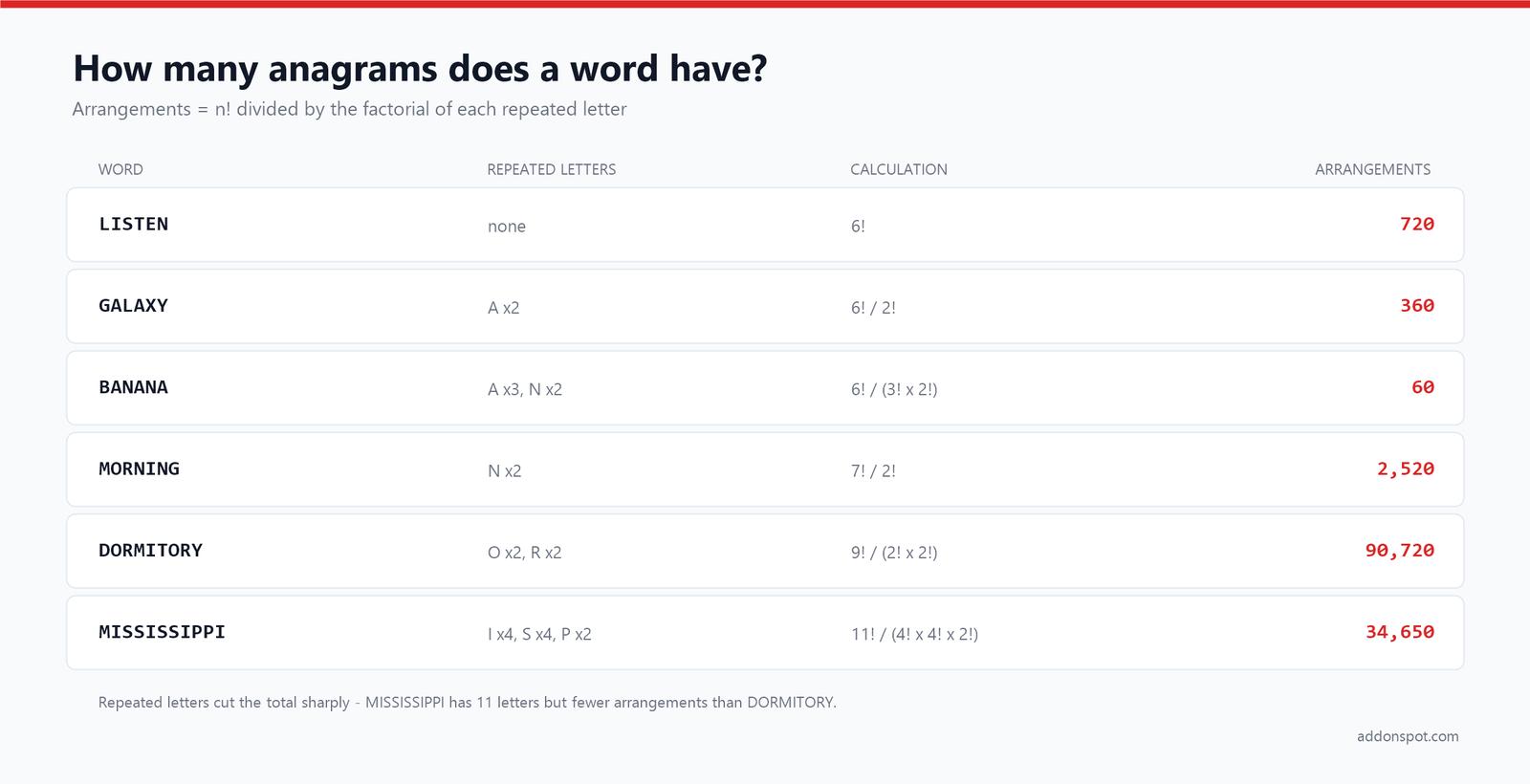
Two things jump out. First, growth is brutal: adding letters multiplies the possibilities, so a ten-letter word already has close to a million arrangements. Second, repeated letters cut the total sharply — MISSISSIPPI has eleven letters but only 34,650 distinct arrangements, fewer than the nine-letter DORMITORY, because so many of its letters are interchangeable.
This is exactly why the tool samples rather than enumerates. Listing all 907,200 arrangements of ASTRONOMER would be useless to read and slow to generate; drawing a batch of 12 to 40 fresh ones and letting you scan them is far more practical.
How the shuffle works
Each result is produced by an unbiased random shuffle of the letter pool — the Fisher–Yates shuffle, which walks the list backwards and swaps each position with a randomly chosen earlier one. It is the standard algorithm for the job because every possible arrangement is equally likely, with no positional bias.
Two filters run on top of it. The tool discards any result identical to your input, so you never get your own word handed back, and it removes duplicates within a batch. In split & regroup mode it then inserts a space at a chosen point, which is a small change with a large effect: the eye reads two short chunks far more readily than one long scramble, so real words surface much faster.
Everything runs locally in your browser. Nothing you type is transmitted or stored — see our privacy policy for specifics.
Example anagrams
| Input | Mode | Sample rearrangements |
|---|---|---|
| listen | Letter shuffles | itnesl, ntisle, snielt (look closely — “silent” and “enlist” share these letters) |
| dormitory | Split & regroup | dorm itory, tomiry rod, moody trir |
| galaxy | Letter shuffles | xaalgy, ygaalx, laxyag |
| morning | Split & regroup | morn ing, grim non, grin mon |
Notice that the split-and-regroup results keep the exact letter pool — MORNING contains two N’s and one G, so every valid rearrangement must too. Checking that letter tally is the quickest way to confirm a candidate is a genuine anagram rather than an approximation.
Famous anagrams worth knowing
The reason anagrams have fascinated people for centuries is that every so often the letters fall into an arrangement that feels almost intentional — a hidden comment on the original. A few classics show what a clean rearrangement can do:
- listen → silent — the two words share every letter, and their meanings quietly mirror each other.
- the eyes → they see — perhaps the most elegant self-describing anagram in English.
- dormitory → dirty room — a rearrangement that doubles as a joke about student housing.
- astronomer → moon starer — a fitting second identity for someone who watches the sky.
- a gentleman → elegant man — the letters agree with the sentiment.
- restful → fluster — a true antigram: the rearrangement means the opposite.
- Clint Eastwood → Old West Action — a celebrity name that anagrams into a description of his films.
Authors use them deliberately, too. In Harry Potter, Tom Marvolo Riddle rearranges into I am Lord Voldemort — a plot point built entirely on an anagram, and one the translators had to rebuild from scratch in every language. Once you start looking, you’ll spot them hidden in book titles, pen names, band names and puzzle clues everywhere.
How to actually solve an anagram
When you are trying to find the hidden word rather than just generate scrambles, a few techniques help:
- Separate vowels from consonants. Seeing which vowels you have to work with quickly narrows the possibilities. English words need vowels at predictable intervals, so a pool with only one vowel behaves very differently from one with four.
- Look for common letter pairs. Groupings like th, ch, sh, st, ing, and ould are the scaffolding of real words — spot them and the rest often falls into place.
- Try the split-and-regroup mode. Breaking a long input into two chunks makes two-word answers far easier to see than staring at one long scramble.
- Work from likely endings. If the letters allow an -ing, -ed, -er, -tion or -ly ending, build backwards from there. Suffixes consume a lot of letters at once.
- Park the awkward letters first. Q, J, X, Z and V fit in very few positions. Decide where they can live and the rest of the word often resolves itself.
- Write the letters in a circle. A classic puzzler’s trick: laying the letters out non-linearly breaks the mental grip of the original order, which is the main thing stopping you from seeing the answer.
- Confirm your find. Because the tool rearranges letters rather than checking a dictionary, verify a candidate is a real word with a reference like the Merriam-Webster dictionary before you rely on it.
Anagrams in crosswords and puzzles
If you solve cryptic crosswords, anagrams are unavoidable — they are among the most common clue types. A cryptic clue splits into a definition and a piece of wordplay, and an anagram clue signals itself with an anagram indicator: a word suggesting disorder or transformation. Once you learn to spot the indicator, the clue mostly solves itself.
| Indicator category | Typical words |
|---|---|
| Disorder | confused, muddled, chaotic, scrambled, in a mess |
| Movement | shaken, stirred, spun, dancing, wandering |
| Damage | broken, shattered, ruined, damaged, injured |
| Cooking | cooked, baked, stewed, mixed, blended |
| Change | altered, converted, adjusted, reformed, novel |
The key discipline is the letter count: the fodder must contain exactly as many letters as the answer. Count them before you start rearranging, and paste the fodder into the tool above when your eye refuses to see it. The conventions are set out in more depth in the guide to cryptic crosswords. The same skill transfers directly to word-scramble games, escape-room puzzles and Wordle-adjacent letter games, where the constraint is the letter pool rather than a clue.
Using anagrams for names, usernames and titles
Because the tool rearranges letters rather than checking a dictionary, the fun part is spotting the combinations that actually mean something. If you are aiming for a clean result, start with words that have a friendly mix of vowels and consonants, and lean on split-and-regroup mode to surface two-word phrases.
A few practical uses:
- Pen names and stage names. Run your full name and see what alter ego falls out. This is a long-standing trick for authors who want a pseudonym with a personal connection.
- Usernames and handles. An anagram of your own name is memorable, personal, and far more likely to be available than the name itself. Take the result to our username and handle generators, or straight to the Gamertag Generator to shape it into a tag.
- Band and project names. Anagrams of a lyric, a hometown or a member’s name give you a shortlist with built-in meaning — the approach in our band-naming framework pairs well here.
- Book and chapter titles. A hidden anagram in a title rewards attentive readers. Pair the idea with the Book Title Generator.
- Brand and product names. Anagrams produce distinctive, coinable strings, which is exactly what you want for trademark and domain availability. Sanity-check any shortlist against our brand name checklist before you register anything.
- Clan and team tags. Short, punchy rearrangements work well as squad names — see the Clan Name Generator.
One caution: an anagram of a real person’s name is still traceable to them, so it is a light disguise rather than genuine anonymity. And before committing an anagram to a business name, check trademark and domain availability properly — a clever rearrangement is worth nothing if the name is already taken.
Why use this anagram maker
- Two modes for two goals. Full shuffle is great for raw variety and username ideas; split-and-regroup nudges results toward readable two-part combinations.
- It never repeats the original. Results are checked so you don’t get your input handed back unchanged, and duplicates are filtered out.
- Unbiased randomness. The Fisher–Yates shuffle gives every arrangement an equal chance, so you are sampling the real space rather than a narrow corner of it.
- Instant and generous. Ask for up to 40 rearrangements at once and regenerate freely — nothing is stored and no signup is needed.
- Handy for wordplay of every kind. Puzzles, pen names, band names, secret messages, or just curiosity about what your name can become.
Frequently asked questions
What exactly is an anagram?
How many anagrams can a word have?
What is the formula for the number of anagrams?
Do the results have to be real words?
What’s the difference between the two modes?
How do I find a real word in the results?
What is the difference between an anagram and a palindrome?
How do I spot an anagram clue in a cryptic crossword?
Is there a length limit?
Can I make anagrams of a full phrase?
Is my input stored or sent anywhere?
Is the anagram maker free?
Related tools and further reading
- Sentence & Word Counter — count letters and words in your text before you scramble them.
- Age Calculator — exact, formula-based date arithmetic in the same collection.
- Gamertag Generator — turn a rearranged name into a tag.
- TikTok Name Generator — shape an anagram into a social handle.
- Book Title Generator — pair a hidden anagram with a great title.
- Brand Name Generator — coin a distinctive name from scratch.
This tool is part of our Text Tools & Calculators collection, alongside the other free generators and tools on AddonSpot. Using anagrams for a pen name or alias? See the naming approach in our band-naming framework, or read up on picking a gamertag that isn’t already taken. More write-ups live on the guides and blog, common questions are answered in the FAQ, and you can always suggest a tool you’d like us to build.