A brand name has to do a lot with very little. It should be short enough to fit on a logo, easy enough to spell that people find you after hearing it once, and distinctive enough to own a corner of your customer’s memory. The Brand Name Generator takes one or two keywords and reshapes them into brandable candidates — blending words together, adding modern suffixes, or trimming a keyword into something that feels invented on purpose. It’s built for founders naming a startup, freelancers launching a studio, and side-project builders who need a name good enough to register today. Enter a keyword, choose a style, and generate a shortlist you can start pressure-testing against domains and trademarks.
Brand Name Generator
Short, brandable business names from your keywords.
Tip: always check trademark and domain availability before you commit to a name.
How to use the Brand Name Generator
- Enter your main keyword. The core idea of your business — “coffee,” “cloud,” “glow.”
- Add a second word (optional). A modifier like “lab,” “hub,” or “co” that the tool can blend into the first.
- Pick a style. Modern/Tech for clean startup names, Playful for friendly consumer brands, Premium for a refined feel, or Mixed for variety.
- Press Generate to see a grid of names, each with a Copy button.
- Shortlist, then verify. Copy your favorites and check domain and trademark availability before you commit.
How does the Brand Name Generator work?
The tool applies a set of established brand-construction techniques to your keywords rather than mashing words together at random. These are the same techniques agencies use, and recognising them helps you judge which results are worth keeping.
| Technique | How it works | Example |
|---|---|---|
| Blending | Overlaps shared letters where two words meet | glow + lab → Glowlab |
| Suffixing | Adds a modern ending to your keyword | coffee → Coffeezy, Glowify |
| Clipping | Trims a word to a shorter, invented-feeling stem | pixel → Pixio |
| Prefixing | Attaches a short particle to the front | glow → GoGlow, Nexpixel |
| Vowel swapping | Alters a vowel to free up a name | cloud → Cloudia |
| Compounding | Joins two whole words cleanly | pixel + hub → Pixelhub |
Why blending beats mashing
When you supply a second word, the generator looks for shared letters at the boundary and overlaps them, or splices at a vowel so the result reads as one smooth name. That is the difference between Glowlab and Glowlaboratory — a blend keeps the syllable count low and the pronunciation obvious, which is exactly what a name needs to survive being said once and remembered later.
Why results stay short
Names are filtered to a brandable character range. Long names fail in the places that matter: they truncate in app icons, wrap awkwardly in logos, and become tedious to type as a domain. If a name cannot be said in one breath and typed without a second glance, it will cost you customers quietly and forever.
Everything runs in your browser — your keywords are never uploaded or stored. See our privacy policy.
Why use this brand name generator
- Smart blending, not random mashups. When you supply two words, the tool overlaps shared letters or splices at a natural vowel boundary, producing names that read smoothly instead of looking bolted together.
- Style changes the personality. The same keyword yields a very different feel in Premium versus Playful mode, so you can match the name to your positioning.
- Length is kept brandable. Results are filtered to a sensible character range, so you won’t waste time on names too long to work as a logo or domain.
- It produces registrable candidates. Blended and invented names are far more likely to clear a trademark search than literal descriptive ones — which is the single biggest practical advantage.
- Fast iteration. Generate, tweak your keywords, and generate again — there’s no limit and nothing to sign up for.
The five types of brand name
Almost every company name falls into one of five categories. Knowing which type you are choosing tells you how much marketing budget the name will demand and how easily you can protect it.
| Type | What it does | Examples | Trademark strength |
|---|---|---|---|
| Descriptive | States literally what you sell | General Motors | Weak — hard to protect |
| Suggestive | Hints at a benefit without stating it | Netflix, Salesforce | Good |
| Invented | A coined word with no prior meaning | Kodak, Xerox | Strongest |
| Arbitrary | A real word unrelated to the product | Apple, Amazon | Strong |
| Founder / place | Named for a person or location | Ford, Adobe | Varies |
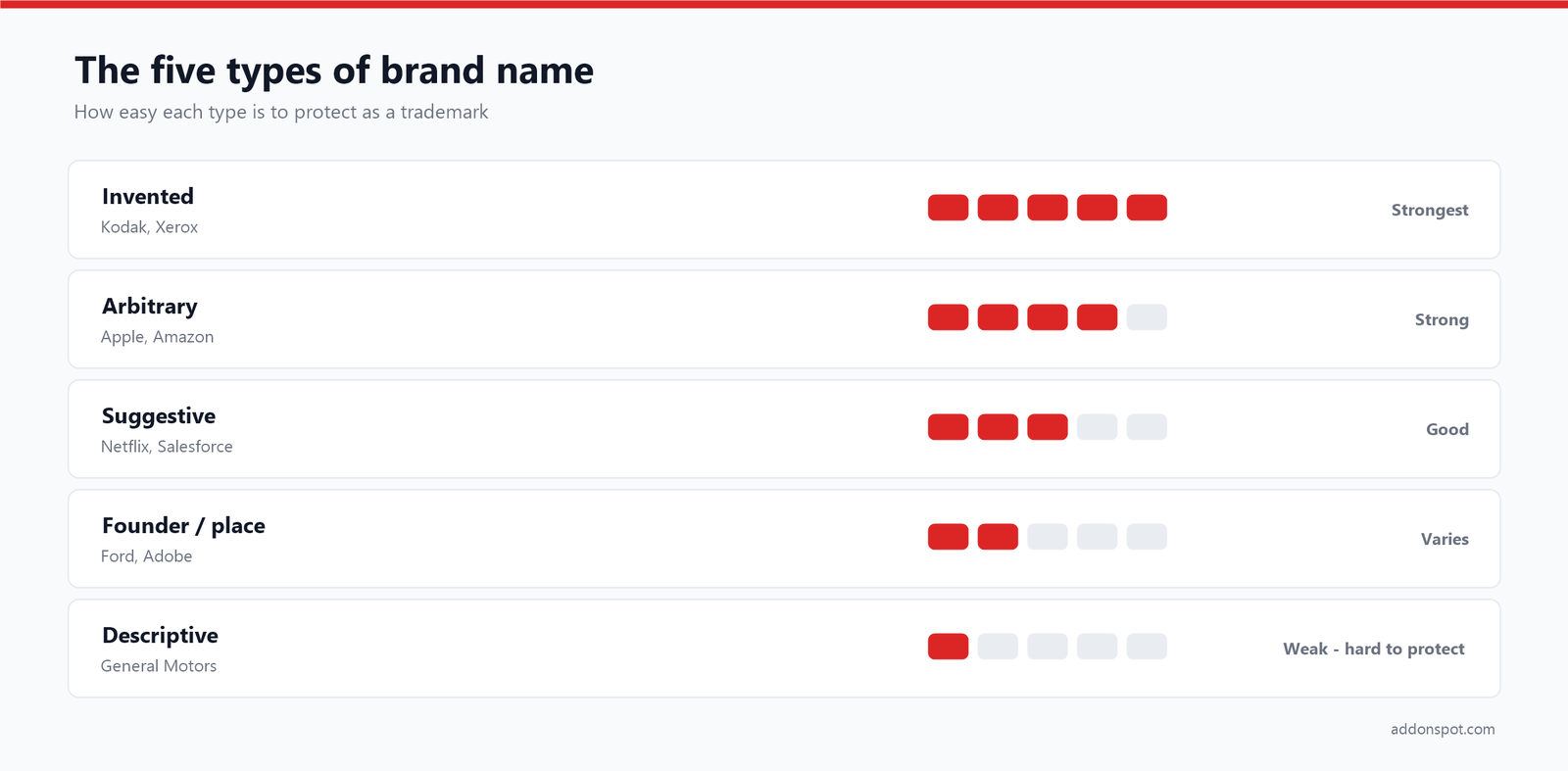
The tension is straightforward. Descriptive names explain themselves, which lowers your marketing cost early — but they are difficult to trademark, because the law is reluctant to let one company own an ordinary description of a product. Invented and arbitrary names mean nothing at first, so you must teach the market what they stand for, but once you do, you own them outright. This generator leans toward the suggestive and invented end, which is usually the right trade for a new business.
Example brand names
| Keywords | Style | Sample names |
|---|---|---|
| glow + lab | Modern | Glowlab, GoGlow, Glowify |
| coffee | Playful | Coffeezy, OhCoffee, Coffester |
| cloud + co | Premium | Cloudia, Cloudoire, Noble Cloud |
| pixel + hub | Mixed | Pixelhub, Nexpixel, Pixio |
What makes a good brand name
The radio test
Say the name aloud to someone who has never seen it written, then ask them to type it. If they hesitate, spell it wrong, or ask “is that with a K?”, the name will leak customers for the rest of its life. This single test eliminates more bad candidates than any other.
Short enough to own
Two syllables is the sweet spot; three is workable. Beyond that, people abbreviate the name themselves and you lose control of it. Aim for something that fits comfortably in an app icon and a browser tab.
Distinctive within your market
A name only has to stand out where you compete. If four rivals all use the same industry root word, adopting it makes you invisible — even if it is technically available.
Room to grow
A name that describes today’s single product becomes a cage. Consider whether it still works if you add a second product line, serve a different customer, or expand to another country.
Clean in other languages
If you might ever sell internationally, check the name against the major languages of your target markets. This is a five-minute check that has saved companies from very expensive rebrands.
Available where it counts
The best name in the world is worthless if the domain is parked at an unaffordable price and every handle is taken. Availability is a real design constraint, not an afterthought.
From shortlist to a name you can register
A name only counts once you can actually use it. Before you fall in love, work through these checks in order — each one is cheap, and each one has ended a naming process that had already gone too far.
- Domain. A clean .com is ideal, but a strong .co or .io can work. Beware near-misses that invite typos or already belong to someone else.
- Social handles. Check every platform you plan to use. Taking your second-choice name consistently beats your first choice on one platform only.
- Trademark. The check that matters most, because a conflict can force a costly rebrand years later. Start with a free search of the official register — in the US that is the USPTO trademark database, and the WIPO Global Brand Database covers marks across many countries at once.
- Existing traders. Search the plain name plus your industry. An unregistered business already operating under it can still create real problems.
- Search results. Google the name. If page one is dominated by something established, you will fight that forever.
- Say it to five people. Ask what they think you sell. Their answers are worth more than your own certainty.
Trademark law is genuinely more subtle than a name search suggests — protection is granted within classes of goods and services, so an identical name can coexist in an unrelated industry while a merely similar one in your own field blocks you. If a name is going to carry real money, a short consultation with an attorney is cheap insurance. Our brand name checklist before you buy a domain walks through the full sequence.
What to do when the .com is taken
This is the most common blocker, and it rarely needs to end the process. Your realistic options, roughly in order of preference: add a short, natural modifier such as get, try, use or hq to the domain while keeping the brand name itself clean; choose a modern extension that fits your sector, since .io, .co, .app and .studio now carry little penalty; alter the name slightly using the generator’s blending and clipping techniques until a clean domain appears; or approach the current owner if the domain is parked and unused, budgeting for a real negotiation rather than a bargain.
What to avoid: hyphens, doubled letters, and deliberate misspellings of the exact domain you wanted. Each of these sends a steady trickle of your traffic to whoever owns the version people naturally type. If the .com is an active business in your industry, treat that as a stop sign rather than an obstacle — you are heading toward a trademark conflict, not just a domain problem.
Common brand naming mistakes
- Deliberate misspellings. Kwik, Fotoz and Lyte make you unsearchable and force you to spell the name every single time.
- Dropped vowels. The Flickr era is over, and removing letters now reads as dated rather than modern.
- Names that box you in. A city or single product baked into the name limits you the moment you expand.
- Hyphens and numbers in the domain. They get lost in speech and mistyped constantly.
- Choosing by committee. Group voting reliably selects the least objectionable option, which is rarely the most memorable one.
- Falling in love before checking. Run availability checks on the shortlist, not on the winner.
Frequently asked questions
How does the tool blend two words?
What are the five types of brand name?
Are the generated names available to trademark?
What makes a good brand name?
Should my brand name include a keyword from my industry?
How do I check if a business name is already taken?
How long should a brand name be?
Does it check domain availability?
Can two companies have the same name?
Is the brand name generator free?
Related tools and further reading
- Book Title Generator — for product, book, or campaign names.
- TikTok Name Generator — secure a matching social handle.
- Sentence & Word Counter — polish your tagline and bio length.
- Anagram Maker — coin a name from letters you already own.
- Gamertag Generator — short, punchy strings that also work as product names.
- Clan Name Generator — for community and team brands.
Explore the full brand and book name generators collection and the rest of the free tools on AddonSpot. Ready to register? Work through our brand name checklist before you buy a domain, and if you are naming a creative project rather than a company, the band-naming framework covers the same ground from a different angle. More guides live on the blog, common questions are answered in the FAQ, and you can suggest a tool any time.