The right title does two jobs at once: it captures what your book is about and it makes a stranger want to open it. That’s a tall order for three or four words, which is why so many writers stall on it. The Book Title Generator gives you a running start. Feed it a theme — a subject, an emotion, an object at the heart of your story — pick a genre, and it returns a list of working titles shaped to that genre’s conventions. It’s built for novelists hunting for a hook, non-fiction authors who want something crisp on the cover, and anyone brainstorming a series who needs a dozen directions to react to. Titles are personal, so treat these as sparks: the one you love might be a suggestion you edit rather than take whole.
Book Title Generator
Evocative working titles for your novel or non-fiction.
How to use the Book Title Generator
- Enter a theme or subject. A single evocative word works best — “memory,” “ocean,” “revenge,” “habits.”
- Choose a genre. Fantasy, Thriller/Mystery, Romance, or Non-fiction each pull from a different set of title shapes; pick Any to mix them.
- Set how many you want — 10 for a quick scan, 20 for a broad brainstorm.
- Press Generate to see a list of titles, each with a Copy button.
- Save and remix. Copy the ones that resonate, then adapt the wording to fit your voice.
How does the Book Title Generator work?
Titles are not random phrases — each genre has a small set of grammatical shapes that readers recognise instantly. The generator fits your theme word into those shapes, which is why results feel appropriate to the genre rather than generic.
| Title shape | Pattern | Example with “ocean” |
|---|---|---|
| Possessive epic | [Noun] of [Theme] | Empire of Ocean |
| Definite article | The [Theme] [Noun] | The Ocean Throne |
| Kinship | [Relation] of [Theme] | Daughter of Ocean |
| Withheld knowledge | What the [Theme] [Verb] | What the Ocean Knew |
| Temporal | Before / After the [Theme] | Before the Ocean |
| Instructional | The Art of [Theme] | The Art of Ocean |
Everything runs in your browser. Your theme word is never uploaded and nothing is stored — see our privacy policy.
Why use this book title generator
- Genre-aware phrasing. A fantasy title and a non-fiction title are built differently — “Empire of…” versus “The Art of…” — and the tool respects those patterns so results feel appropriate, not generic.
- It defeats the blank page. Reacting to twenty options is far easier than inventing one from nothing; often the winning title is a tweak of something the tool surfaced.
- Theme stays central. Every suggestion is built around the word you entered, keeping the list tethered to what your book is actually about.
- It reveals the patterns. Seeing twenty titles in the same shape teaches you the conventions of your genre faster than reading advice about them.
- Endless, free brainstorming. Regenerate as often as you like — no signup, no limit, nothing stored.
Title conventions by genre
Readers browse by pattern recognition. A title that follows the conventions of its shelf signals “this is for you” before anyone reads the blurb — and one that ignores them creates friction, however elegant it is.
| Genre | Typical shape | Length | Signals |
|---|---|---|---|
| Fantasy | Of / The [Noun] constructions | 3–5 words | Scale, world, lineage |
| Thriller / Mystery | Withheld information, definite article | 2–5 words | Secrecy, threat, a question |
| Romance | Pronouns, seasons, warmth | 2–5 words | Intimacy, longing, time |
| Literary fiction | Concrete image or object | 1–4 words | Restraint, ambiguity |
| Non-fiction | Benefit plus explanatory subtitle | 2–4 + subtitle | Authority, promise, outcome |
| Memoir | Short phrase, often a fragment | 1–4 words | Voice, specificity |
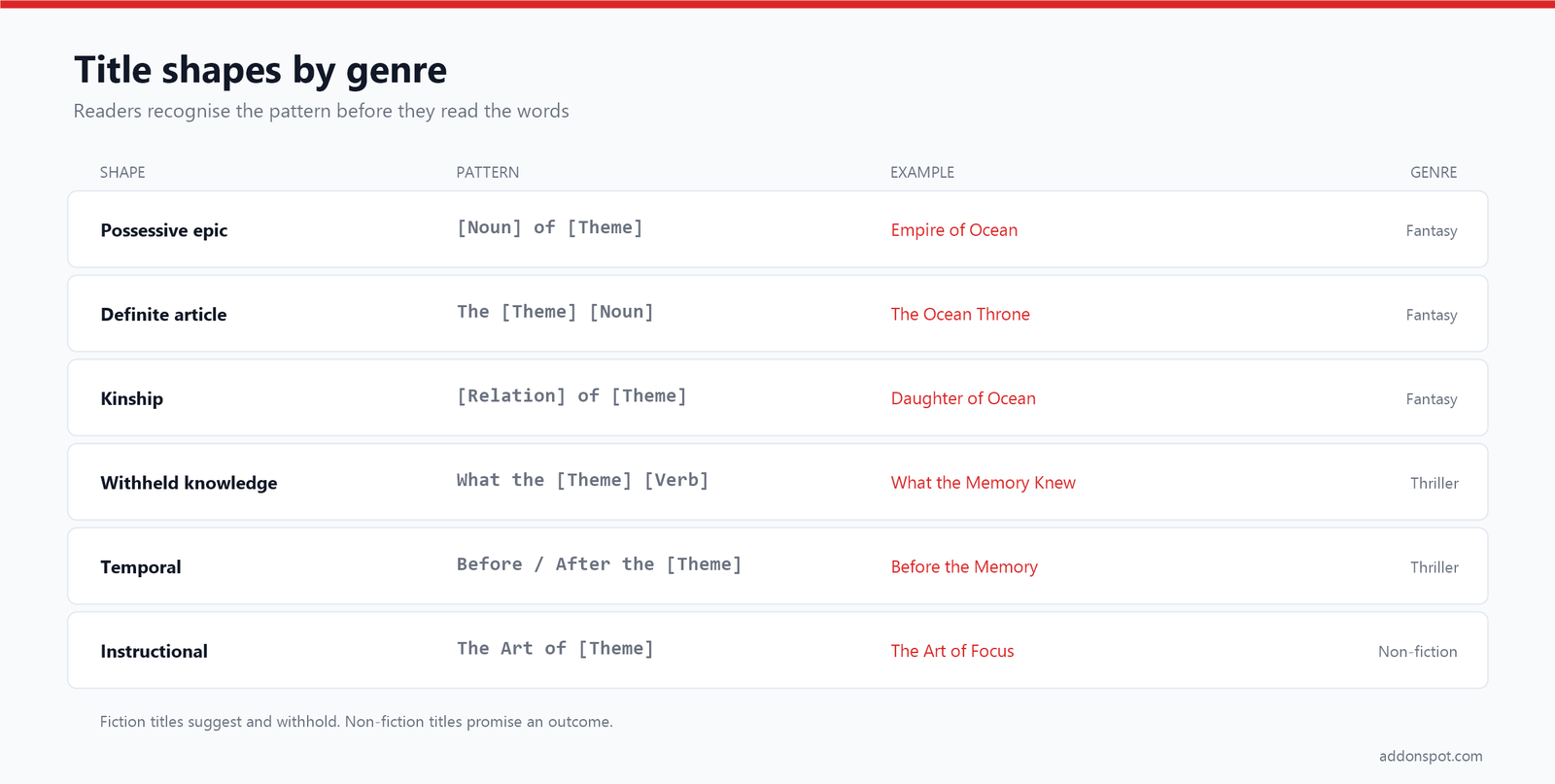
Fiction titles suggest; non-fiction titles promise
This is the most useful distinction in titling. A novel’s title creates curiosity and mood — it should raise a question rather than answer one. A non-fiction title makes a promise about what the reader will gain, and clarity beats cleverness every time. The Ocean Throne works for fantasy precisely because it withholds; the same ambiguity on a business book would sink it.
Example book titles
| Theme | Genre | Sample titles |
|---|---|---|
| ocean | Fantasy | Empire of Ocean, The Ocean Throne, Daughter of Ocean |
| memory | Thriller | What the Memory Knew, The Silent Memory, Before the Memory |
| summer | Romance | The Summer of Us, Almost Summer, Yours, Summer |
| focus | Non-fiction | The Focus Advantage, The Art of Focus, Mastering Focus |
What makes a title work
It is easy to say and remember
Books spread by word of mouth more than by advertising. A title someone can repeat accurately after hearing it once is doing marketing work every time it is mentioned; one that gets garbled loses the recommendation entirely.
It survives the thumbnail
Most readers first meet your book as a postage-stamp image on a phone. Read your shortlist at that size — long titles become illegible, and a designer will be forced to shrink the type until the cover loses its impact.
It is searchable
Readers who half-remember your book will type the title into a search box. A title made of very common words buries you; a slightly distinctive one surfaces immediately. This is a practical concern, not a poetic one.
It sets an accurate expectation
A title that oversells or mismatches the genre produces the most damaging outcome in publishing: readers who buy, feel misled, and leave poor reviews. Intrigue is good; misdirection is not.
It leaves room for a series
If book one might become book three, choose a title with a repeatable pattern. Series that share a grammatical shape are far easier for readers to collect and for retailers to group.
Writing a non-fiction subtitle
For non-fiction, the subtitle often sells the book more than the title does. The reliable structure is a short, memorable main title followed by a colon and a specific promise:
| Component | Job | Example |
|---|---|---|
| Main title | Memorable hook, 1–3 words | The Focus Advantage |
| Subtitle | Who it’s for and what they gain | How to Do Deep Work in a Distracted World |
Strong subtitles usually name the audience, the outcome, or the timeframe — and often all three. Keep the whole thing under about fifteen words; anything longer stops being a subtitle and starts being a paragraph. Our Sentence & Word Counter is useful here for keeping the title, subtitle and back-cover blurb within their limits.
Naming a series
Series titles work when they share a visible pattern, so a reader spotting book four instantly knows it belongs with the others. Three approaches that hold up:
- Fixed frame, changing noun. Empire of Ocean, Empire of Ash, Empire of Salt — generate several titles around one theme and the pattern usually appears by itself.
- Shared grammatical shape. Every title is “The [Adjective] [Noun],” which links the books without repeating a word.
- Numbered arc with a series name. A distinct series name above individual titles, which gives you the most freedom per book.
Whichever you choose, check that the pattern still works for a title you have not written yet. Patterns that depend on a specific word run out surprisingly fast.
Can two books have the same title?
Legally, yes. Book titles generally are not protected by copyright, which is why multiple books share the same title — and why you will find several novels called Home. Series names and highly distinctive titles can sometimes be trademarked, but a single ordinary title usually cannot.
Practically, though, sharing a title with a well-known book is close to self-sabotage. You inherit none of its recognition and all of its search competition: your book sits beneath the famous one in every result, every recommendation algorithm, and every store search. Readers looking for you will find someone else.
Before committing, check the exact title against a large catalogue. Open Library and Goodreads both make clashes obvious in seconds, and searching your own genre alongside the title will reveal whether you are stepping onto occupied ground. If you are self-publishing, you will also need an ISBN for each format — the International ISBN Agency lists the official agency for your country.
Testing your shortlist
Once you have three or four candidates, stop deciding alone. Writers are the worst judges of their own titles because they know the book too well — a title that feels resonant to you may say nothing to someone who has not read a word.
- The cold read. Show only the title to someone unfamiliar with the book and ask what they think it is about. Their answer reveals the real signal you are sending.
- The thumbnail test. Mock the title onto a cover-sized rectangle and shrink it to phone size.
- The recall test. Mention the title in conversation, then ask the same person a day later to recall it.
- The shelf test. Read it aloud among the actual bestsellers in your genre. Does it belong, and does it stand out?
- A small poll. Ask your target audience which they would pick up. A poll often reveals which title genuinely pulls people in versus which one only you love.
Common titling mistakes
- Naming the theme instead of the book. One-word abstractions such as Loss or Courage feel profound to the author but tell a browsing reader nothing and are impossible to search.
- Using a character name nobody knows yet. It works for an established author and does very little for a debut, because the name carries no meaning until after the book is read.
- Burying the hook behind a long clause. If the interesting word arrives fifth, it will be cut from every listing that truncates.
- Chasing a current bestseller’s formula. By the time a pattern is obvious enough to copy, the shelf is already full of imitations and yours reads as the last one in.
- Ignoring how it sorts alphabetically. Titles beginning with “The” behave unpredictably in catalogues and library systems.
- Committing before the book is finished. Manuscripts drift. A title chosen at chapter three often describes a book you no longer wrote.
Frequently asked questions
Can I use a generated title as-is?
Can two books have the same title?
How long should a book title be?
Does genre really change the title?
How do I write a good non-fiction subtitle?
What theme word should I enter?
Is it useful for series titles?
Can a book title be trademarked?
How do I test a book title before publishing?
Is the book title generator free?
Related tools and further reading
- Brand Name Generator — for pen names, imprints, or series brands.
- Anagram Maker — hide a clue or craft a pen name from your own.
- Sentence & Word Counter — check your blurb and chapter lengths.
- TikTok Name Generator — a handle for your author platform.
- Age Calculator — useful for pinning down dates in historical fiction.
Browse the full brand and book name generators collection, or the rest of the free tools on AddonSpot. Naming a creative project more broadly? The framework in naming your band transfers neatly to titles and pen names, and our brand name checklist covers the availability checks worth doing before you build an author website. More guides live on the blog, common questions are answered in the FAQ, and you can suggest a tool any time.